
⏱️ Estimated reading time: 12 min

On this page: Overview
Key Takeaways
Use a rubber tip or walking cap whenever the ground is hard and smooth: pavements, tarmac lanes, concrete farm tracks, boardwalks and polished rock in towns or at popular viewpoints. The cap grips better than a bare tip on these surfaces, is quieter and leaves fewer marks. Take it off again for mud, grass, loose stones and rough hill paths.
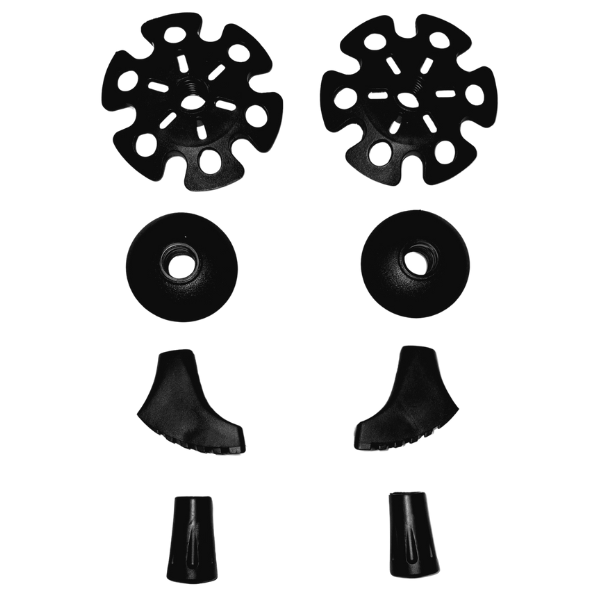
A snow basket is a wide disc that sits just above the tip. In soft snow it spreads the load, so the pole stops at the surface instead of sinking up to the grip. Small trekking or mud baskets do the same on soft summer ground. Neither turns poles into winter safety kit: on steep snow you still need the right equipment and skills.
The two folding models. The Expedition Pro and the 3K Carbon Extreme+ each come with a trekking tip, a walking cap and a snow plate. The telescopic Alpine Explorer comes with a trekking tip and a walking cap, without a snow plate.
There is no fixed interval. It depends on how much hard ground you walk on. Check the tips and caps before each trip: replace a cap once it is worn through, split or loose, and have a tip looked at once it is blunt, chipped or no longer bites on rock. Walkers who cover a lot of tarmac go through caps fastest.
You can, but it is not ideal. A bare hard tip tends to skid on smooth paving and tarmac, clicks with every step and can scratch stone. Fitting a walking cap before you reach the road gives you better grip, a quieter walk and fewer marks. Swap back to the bare tip when you return to the hill path.
The bottom few centimetres of a trekking pole do most of the work. Every time you plant a pole, the tip has to grip, and on a long day that can mean thousands of plants on rock, mud, grass, tarmac and, in winter, snow. No single tip suits all of those surfaces, which is why poles come with a few interchangeable ends.
This guide explains what each one is for: the hard trekking tip, rubber tips and walking caps, small trekking or mud baskets, and the snow plate. It also covers when to swap them, how to spot worn tips and what comes in the box with each Bollsen model. If you are still deciding on a pair, start with our guide on how to choose trekking poles.
Which tip or basket for which ground
The quick answer fits in a table. The sections below explain the reasons.
| Ground | Tip, cap or basket | Why |
|---|---|---|
| Rocky hill path, scree, gravel | Bare trekking tip | The hard point bites into rock and loose stones instead of sliding off them. |
| Grass, earth, forest path | Bare trekking tip | Pushes into soft ground for a firm plant. |
| Peaty or boggy ground, deep mud | Trekking tip with a small basket | The basket stops the pole sinking too deep and makes it easier to pull out. |
| Pavement, tarmac lane, concrete track | Walking cap or rubber tip | Better grip on smooth surfaces, quieter, fewer scratches. |
| Boardwalk, paved path, polished rock at busy spots | Walking cap or rubber tip | Protects the surface and grips better than a bare tip. |
| Soft snow below the snow line | Snow plate (snow basket) | The wide disc keeps the pole near the surface instead of plunging in. |
| Hard, icy snow on steep ground | Not a job for poles alone | Winter equipment and skills come first; poles only help on gentle slopes. |
The hard trekking tip
The trekking tip is the bare, hard point at the bottom of the lower section. It is the default for hill paths, and on most British walks it is the one you will use most. A hard point catches on rock edges, digs into earth and gravel and holds on wet grass, so you can lean on the pole with confidence when you step up, step down or cross a slope.
Its weakness is smooth, hard ground. On tarmac, paving slabs and polished rock, a hard tip has very little to grip, so it can skid just when you put weight on it. It is also noisy on hard surfaces and can leave scratch marks on rock, which is why it pays to change the end when the path changes. If you are new to poles, our guide on how to use trekking poles covers where to plant the tip and how to get the rhythm right.
Rubber tips and walking caps for pavements
Covers that slip over the trekking tip go by several names: rubber tips, rubber feet, walking caps or walking pads. They all do the same basic job. Ordnance Survey’s guide to hiking poles recommends rubber tips if you walk a lot on hard-packed tracks or paved roads, and notes that most poles can take one fitted over the spike.
Every Bollsen pole comes with a walking cap for exactly this. Fit it for:
- Pavements and village streets. Better grip on smooth paving and far less clicking.
- Tarmac lanes and concrete farm tracks. Many UK walks start or finish on a stretch of road.
- Boardwalks and paved paths. Common on nature reserves and at busy viewpoints, where a bare tip scratches wood and stone.
- Indoors and on public transport. If you carry the poles extended for a moment, a capped tip is kinder to floors and to other people’s ankles.
Leaving fewer marks also fits the spirit of the Countryside Code, which asks visitors to leave no trace of their visit. A line of fresh scratches across a well-walked slab is a small thing, but on popular paths it adds up.
Caps are also the usual choice for Nordic-style walking on park paths and promenades. If that is what drew you to poles, read what Nordic walking is and our honest look at Nordic walking with trekking poles. Take the cap off again when you leave the hard surface: on mud and wet grass it gives less grip than the bare tip.
Trekking and mud baskets
A trekking basket is a small disc that sits a few centimetres above the tip. On firm ground you hardly notice it. On peat, bog and deep mud it stops the pole from sinking until the basket meets the surface, so each plant gives you support instead of disappearing into the ground. It also makes the pole easier to pull out again.
The British Mountaineering Council describes poles with small baskets as the most suitable choice for summer walking. A small basket also stops the tip slipping too far into gaps between rocks. If a basket keeps snagging on heather or rocks, it is usually a sign the basket is larger than the ground needs.
The snow plate
A snow plate (also called a snow basket) is a much wider disc. In soft snow a bare pole, or one with a small basket, plunges in until you lose the support you were relying on. A snow plate spreads the load, so the pole stays near the surface. For the same reason, the BMC notes that poles for winter use are often fitted with a snow basket.
Two Bollsen models include one: the folding Expedition Pro (snow plate included) and the 3K Carbon Extreme+. The telescopic Alpine Explorer does not come with a snow plate, so if you plan to walk in snow regularly, that is worth knowing before you choose. Our comparison of folding vs telescopic poles sets out the other differences between the two types.
Keep winter in proportion. The kit list for Scottish winter Mountain Leader training at Plas y Brenin, the national outdoor centre in North Wales, describes trekking poles as useful for walking below the snow line and on low-angle snow slopes. On steep or icy ground, poles and snow plates are no replacement for the right winter equipment and the skills to use it. We cover winter walking in more detail in our guide to using poles in snow.
When to swap tips on a walk
A typical British day out mixes surfaces: a lane from the car park, a field path, a rocky ridge, then a road back to the village. You do not need to change ends for every few metres, but a swap at the main transitions makes a real difference.
- Start with what is under your feet. If the walk begins on tarmac, fit the caps at the car.
- Swap at the first stile or gate. You are stopping anyway, so pull the caps off where the path turns to grass or stone.
- Keep the caps in one place. A hip-belt pocket or a small zip pouch saves digging through the rucksack and makes them harder to lose.
- Refit for the road home. The last kilometre on tarmac is where a bare tip skids most.
Push caps on firmly and check them now and then. A loose cap can work its way off in long grass, and that is usually the last you see of it. When you travel, keep the caps fitted while the poles are packed: they protect the tips and everything around them. Our guide to flying with walking poles covers packing for a trip.
Replacing worn tips and caps
Tips and caps are wear parts. Ordnance Survey points out that rubber tips wear out, and the more road you walk, the sooner that happens. Check the bottom of each pole before every trip and replace a part when you see:
- a cap worn thin or through at the bottom, so the hard tip shows;
- a cap that is split, cracked or no longer stays on firmly;
- a trekking tip that is blunt, chipped or skids on rock where it used to grip;
- a basket or snow plate that is cracked or missing.
For spares, the BOLLSEN attachments set is a set of replacement attachments sold separately from the poles. If you are not sure whether a spare part suits the model you own, ask us before you order. To keep tips, caps and the rest of the pole in good shape between walks, see our guide on how to look after your poles.
What comes in each Bollsen box
All three Bollsen models include a trekking tip and a walking cap, so you can walk on hill paths and on pavements from day one. The difference is the snow plate.
- Alpine Explorer: telescopic aluminium, 247 g per pole, 95 to 135 cm, suits walkers from 1.40 to 2 m. In the box: trekking tip and walking cap.
- Expedition Pro: folding 7075 aluminium, 297 g per pole, 37 cm folded, 115 to 135 cm, suits walkers from 1.60 to 2 m. In the box: trekking tip, walking cap and snow plate.
- 3K Carbon Extreme+: folding 3K carbon, 199 g per pole, 37 cm folded, 115 to 135 cm, suits walkers from 1.60 to 2 m. In the box: trekking tip, walking cap and snow plate.
If weight matters as much as the box contents, our guide to carbon vs aluminium poles compares the materials. Every Bollsen pole comes with a 40-day money-back guarantee, so you have time to try the tips, caps and snow plate on your own paths.
Pingback: Walking Poles in Snow: Winter Walking Guide | BOLLSEN